
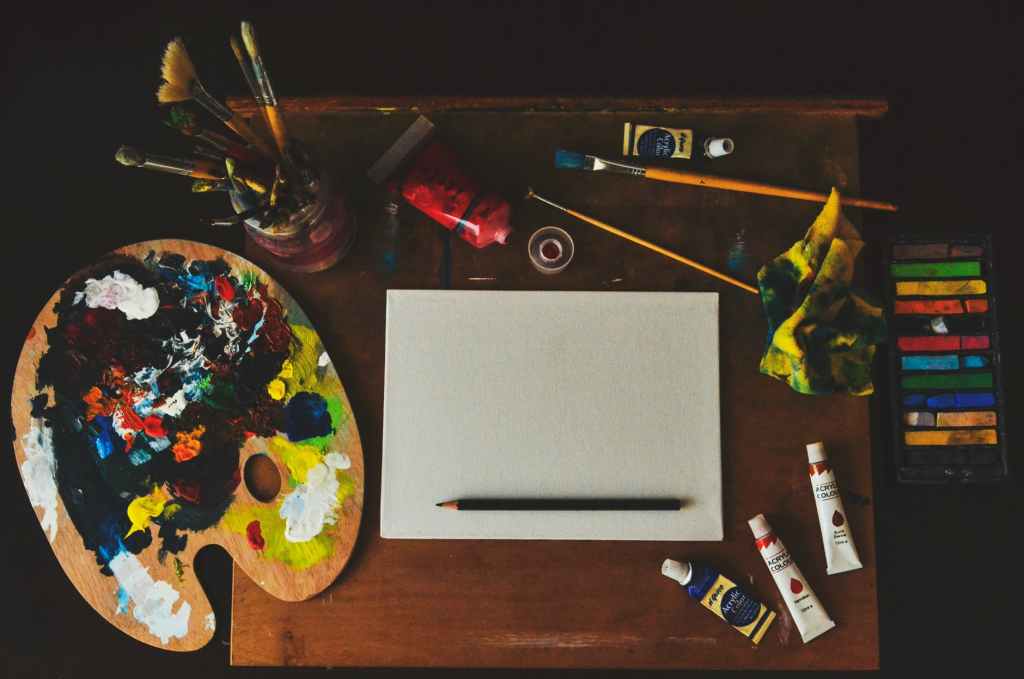
This post is about “the psychology of artists” (a frequently examined topic in industry and academia) but is aimed toward practical methods of overcoming self-doubt commonly experienced by artists.
I have many discussions with fellow artists about the “journey” of creating art. Within this discussion is a common topic of self-doubt. It turns out it is not uncommon to feel self-doubt throughout the various stages of a creative project.
I have found it is ultimately the case for every creative project I have worked on to a varying degree. This is also the case with every artist I have ever asked about the topic.
So the question is: Why, and how do we overcome it?
Why? Because making art is full of unknowns. It can feel a lot like wading waters in the ocean (a feeling I am familiar with being that I am from California).
When you are wading the ocean’s waters the ocean feels massive, unpredictable, and not entirely conceivable. You feel as if you don’t know where it starts, and you can’t imagine where it might end. Maneuvering in any direction becomes challenging as your body is battered by the unforgiving rise and fall of the heavy waters around you. Your internal compass (where you want to go) can become garbled as your body and mind try to adjust to all the overwhelming feedback of the ocean, including the stinging of salt water in your eyes.
For this reason I understand why, for many, the idea of wading open waters is terrifying.
Yet it may also be seen as exhilarating, invigorating, captivating. A thing of unparalleled beauty. A place where every one of these feelings is completely new and thrilling. Where murky chasms may also be seen as full of potential for new experiences.
The act of creating, in whatever form, can feel like wading the ocean’s waters. The creative space is a vast, always unexplored (because no two projects are exactly the same) and therefore unpredictable. A space which can be both scary and beautiful simultaneously. A space where your imagination and technical aptitudes are constantly challenged by the battering of all the information we receive and manage during any given project. This space is also very unforgiving, where even the small decisions can turn into major problems down the line. If you don’t have what you need to successfully navigate the creative space, it is quick to overwhelm you.
With all this in mind it is no wonder artists experience anxiety and self-doubt.
One of the most frustrating things about feeling self-doubt when creating is you fear the murky chasms. You steer clear and swim the safe route, the waters frequently traveled. This often leads to work that is average- the bane of my existence as an artist.
Which is why I am writing. I want to talk about the things that help me when I am navigating the creative space because I don’t like feeling restrained by self-doubt and I figure you don’t either. In fact overcoming self-doubt is crucial if you want to enjoy the creative process.
Before diving deeper into how I overcome this, it is important I mention there are other discussions around this topic of anxiety in art-making. One way in which it has previously been discussed is through the idea of the “Imposter Syndrome”. Another, is through ideas around confidence on the part of the creator. These are worth exploring. At least as proof you’re not alone, if not for the information.
Now, onto how I overcome this pesky self-doubty thingy, in the form of a nifty list!
I Embrace Constraints: I don’t view constraints as a “limitation”. In the creative space, it can be productive to split that hair and view constraints as “guidelines”, instead. They are a frame for you to think in. I embrace constraints because instead of grappling with the vast unknown of all the oceanic waters before you, a constraint allows you to find a direction within the boundary of a specific space. You only have to solve the problems inside of those guidelines. Many questions are subsequently answered for you. Answers granted to you are answers you don’t have to search for. This is always a pleasure.
I should note, I have an open minded understanding of what a constraint is. I view anything from theme, to a specific subject your trying to tackle, to something simple like time constraints, as a constraint. Although there may be variation on what we call a constraint, I think it is crucial regardless to embrace working within them. If you feel choices in a creative project seem endless, then guidelines around what you can and can’t do may lead you to clarity, helping you overcome that self-doubt, freeing you up to focus on turning nuthin’ into sumthin’!
I Have a Creative Process: I spent time organizing and materializing the process I use to create. I found a method to my madness. It is not a prison, just a framework. So something fairly general works. First off, you have to be honest with yourself about when and where you work best. What are your habits? When do you hit a flow state? Do you work best in coffee shops? What time of day? You need to know. Once you have an ideal environment and time of day in mind, try to work it in. If not, it isn’t the end of the world. Part of being professional is being able to deliver exceptional work even in less than ideal circumstances. So it is good practice.
Moving on. Here are some important aspects of my creative process:
- I always, always, arrive with a cup of coffee. It is like my totem. I plant it on the desk in front of me and it shouts “get to work”. I know people who use humidifiers, candles, a Smell-o-Tron 5000. Whatever. Find your totem, use it every time.
- I hide my phone out of sight. If it is in my pocket, if it is on the desk, it will buzz, ring, or beckon my attention in any way it can. I get rid of it.
- I eliminate all other distractions. I use music to drown out everything. For me, silence is distracting. If I can hear myself moving, I get distracted. I need chaos. I make that happen by working in coffee shops while wearing headphones.
- Be somewhere “boring”. Because, if there is nothing else to do other than work, then screw-it, you might as well work! Boredom is highly conducive to creativity! In Stephen King’s book “On Writing: A Memoir of the Craft“, he describes how some of his best ideas have come during his daily walks. He expresses how having nothing else to do but walk- listening to the same birds, the same winds, and seeing the same trees, stumps, and weeds he always sees- gives him nothing else to do but focus on generating those pesky ideas.
I Get Help From My Team/Community: Projects are full of decision-making. This is where friends, family, professors, teammates, anyone, can really make your life a lot easier. Since it is not uncommon for me to question myself into the dirt at the start of a project, I’ll usually solve this problem by just running my ideas by people I can trust. This is most often my girlfriend or my brother. This helps clarify my thought processes. It at least lets me know whether or not my ideas can be articulated into sentences. If I find myself able to fluently express my idea, then I know it makes some amount of sense, even if the listener is of the opinion that my idea sucks. If not, then I know I have more thinking, or rethinking, to do.
I know not all of us are great at verbal communication. But no worries! Write it down. I keep a 3×5 Field Notes on me at all times to help me with that. You know what, though? Heck, just start talkin’. The more you practice talking about your work, the better you’ll get at it. Sometimes I even talk to myself… but I’m not so sure I recommend that.
Complete your Projects : The importance of this point can not be overstated. Completed projects are key in relieving self-doubt. With every completed project, no matter how small, I am awarded another layer of confidence which helps me remember I am capable even when I feel doubtful. I may not love the work I complete every time, I may even hate it, but I am always better off by completing it.
I have to mention this is one of the biggest challenges I have come across as an artist, and I am by no means perfect on this account. Some times other obligations get in my way, maybe I move on to other ideas. Sometimes I just let myself give up. But this is precisely what we have to learn to overcome. No artist ever became an artist by not making art. If it is never completed, then it is never truly made.
“The road to hell is paved with works-in-progress”
-David Roth
In Conclusion: If you find yourself staring at that blank page of paper feeling anxiety about where to start, know that your not alone. Check out some of the great written and spoken pieces on creating art to help with the psychological factors of art making. Aside from that, create constraints for your projects or embrace them when they are provided to you. Develop a creative process, or workflow, as many of the masters have. Finally, utilize collaboration and communication with friends, family, and teammates in the process. Bounce your thinking off of teammates, ask questions, and seek inspiration! Then dive head first into the grind and don’t stop until the project is done!
I Hope this helped!
Cheers,
Arjuna Noah Paul Leri

 Arjuna Leri
Leave a comment